Measuring the engine of a liquidation cascade: subcritical branching inside a first-order transition
发表于 2026年8月5日上传于 2026年8月5日
A record study of seven major crypto perpetual cascades (2022–2025) shows the transition signature is first-order and liquidity-driven rather than critical. In-flight measurements during the October 2025 cascade indicate subcritical branching (λ ≈ 0.1–0.2) with front-loaded forcing and substantial off-book absorption by the venue backstop. Across measures, the order parameter jumps while the susceptibility collapses, and the in-cascade liquidity signature—price-impact spikes and open-interest-clearing—appears universal. The branching model is falsified as an explanatory pre-cascade state, linking severity to shock, map-in-path, and liquidity withdrawal rather than a diverging multiplier
NULL-VALIDATED TOPOLOGICAL SIGNATURES OF FINANCIAL MARKET DYNAMICS
发表于 2026年7月31日上传于 2026年8月4日
We present a null-validated topological analysis of Bitcoin and S&P 500 returns, using the L1 norm of persistence landscapes from sliding-window delay embeddings as a dynamic geometry descriptor. The topological signal co-moves with stochastic volatility during stress periods, but the strength and temporal pattern of this association vary across markets. Surrogate-based null models (shuffle and phase-randomized) reject explanations based on marginal distributions or linear second-order dependence alone, indicating sensitivity to nonlinear and phase-dependent temporal organization beyond traditional volatility metrics. The results show that persistence landscape norms provide complementary information about market dynamics across regimes and markets
Quantum Kernels and the Cross-Section of Stock Returns: Anatomy of a Vanishing Advantage∗
Denoising Subordinated Probabilistic Models: Diffusion with a Tempered-Stable Volatility Clock, and What the Noise Mechanism Actually Controls
发表于 2026年7月21日上传于 2026年7月22日
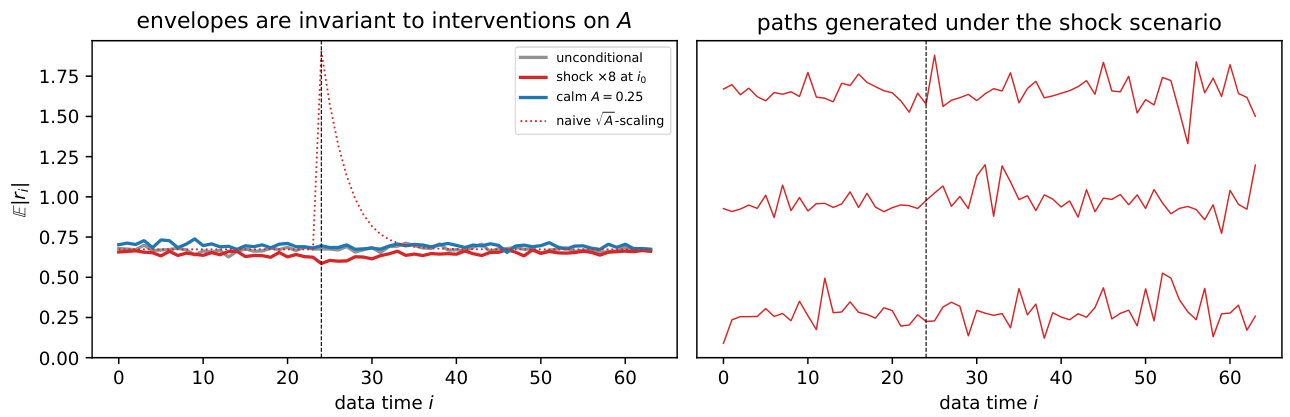
Heavy-tailed extensions of denoising diffusion models replace the Gaussian noise by a Gaussian variance mixture εi = Ai zi: denoising Lévy probabilistic models (DLPM) take the mixing variables Ai i.i.d. across coordinates, Student-t EDM takes a single A shared by all coordinates. Neither extreme has dynamics, yet temporal dependence of the noise amplitude— volatility clustering—is the defining stylized fact of the financial data these models target. We introduce the Denoising Subordinated Probabilistic Model (DSPM), whose mixing vector is a stationary AR(1) chain driven by tempered-stable subordinator increments—the discretetime Barndorff-Nielsen–Shephard stochastic volatility process—running along the data axis. Conditionally on the chain, the entire DDPM machinery survives verbatim, and we prove closed-form identities linking the chain parameters to the excess kurtosis and the squarednoise autocorrelation, yielding an exactly identified, analytically invertible calibration with a falsifiable feasibility bound ρr2(1) < K/(3(K + 2)). DDPM, DLPM-type stable noise, and shared-scale Student-t-type noise are boundary cases of one memory parameter. We then prove a result that delimits the entire design space: if the denoiser is conditioned on A (as sufficiency demands), the mixing law is a nuisance—in the exact-denoiser limit the generated distribution is invariant to it, and interventions on A have no effect. Controlled experiments (identical denoiser, schedule, budget; only the law of A or the conditioning bit varies) confirm both halves: conditioned models match the data’s clustering regardless of the mixing law, and a designed 8 volatility shock moves the generated amplitude envelope by less than 13% against a naive prediction of +183%; blind models transmit the noise structure exactly as calibrated—lag-one squared-return autocorrelation 0.151 against the calibrated 0.161 with the predicted geometric decay, while the i.i.d. variant’s clustering collapses to 0.008. The mixing law controls what structure the noise offers; the conditioning bit controls whether it transmits. Finally we close the loop (v2): coupling the chain to the data through a variational volatility encoder (with a log-normal volatility prior, for closed-form KL) restores control—provided the objective retains the stochastic-volatility likelihood whose log-determinant term the simplified denoising loss discards; naive β-weighted couplings collapse or leak, and both failure modes are documented. With it, the same 8 intervention scales the envelope by 3.07 (naive scaling: 2.83), the encoder tracks the true latent volatility of held-out paths (per-path correlation 0.57; 0.76 pooled), and the learned prior memory moves from its moment-calibrated initialization toward the true persistence. The cost is substantial and stated plainly: the coupled model’s unconditional kurtosis falls below even the Gaussian baseline—fidelity and control are demonstrated separately, not yet jointly.
AN EXTREME VALUE PERSPECTIVE ON LEARNING STRESS LAWS
Adaptive AI Delegation under Uncertainty: A Bayesian Governance Policy for Sequential Decision Authority
发表于 2026年6月30日上传于 2026年6月30日
本研究将 AI 治理问题从单纯预测转向对权威分配的动态优化,提出一个以贝叶斯为基础的治理感知POMDP框架,用以在证据质量、不确定性和机构目标演变时,持续动态调整 AI 推荐的决策权限。通过合成压力测试、预测精度验证和历史市场回放,验证该治理策略在不同 AI 质量情境下的鲁棒性、可解释性与可操作性,且在与五种基准治理机制对比中展现出更强的一般化能力和稳健性。
Liquidity-Based Audit of Algorithmic Trading Strategies
Pump.fun Graduation Regime Windows: Survival Analysis of 832,941 Token Launches and the Social-Presence Effect
发表于 2026年6月10日上传于 2026年7月7日
We present a Kaplan-Meier and Cox proportional-hazards survival analysis of 832,941 Solana pump.fun token launches with 24-hour graduation outcomes observed between 2026-05-08 and 2026-06-10, yielding a pooled graduation rate of 0.198% (Wilson 95% CI [0.189%, 0.208%]) . We formalise the Graduation Regime Windows (GRW) framework and designate the 34-day REDPUMP-2026-v1 regime, releasing the underlying 860,213-launch dataset under CC-BY-4.0 on Zenodo with a frozen schema . Social-presence features are highly predictive: the Telegram indicator alone producing an 8.94× lift (HR 5.40, 95% CI [4.73, 6.17], p = 6.6 × 10−138) and launches advertising all three social channels yielding a 17.4× lift versus none . The top quartile (mcap > 31 SOL) graduates at 0.634%, nearly matching the Marino et al. (2026) pooled rate, suggesting the cross-regime decline is largely due to compositional shifts toward zero-self-buy launches rather than a decline in self-buy success rates . We introduce the GRW framework and Pump.fun Graduation Index (PGI) as standardized anchors for future work, and provide reproducible code and data access details .