Signature-Based Optimal Execution for Statistical Arbitrage with Path-Dependent Trading Signals
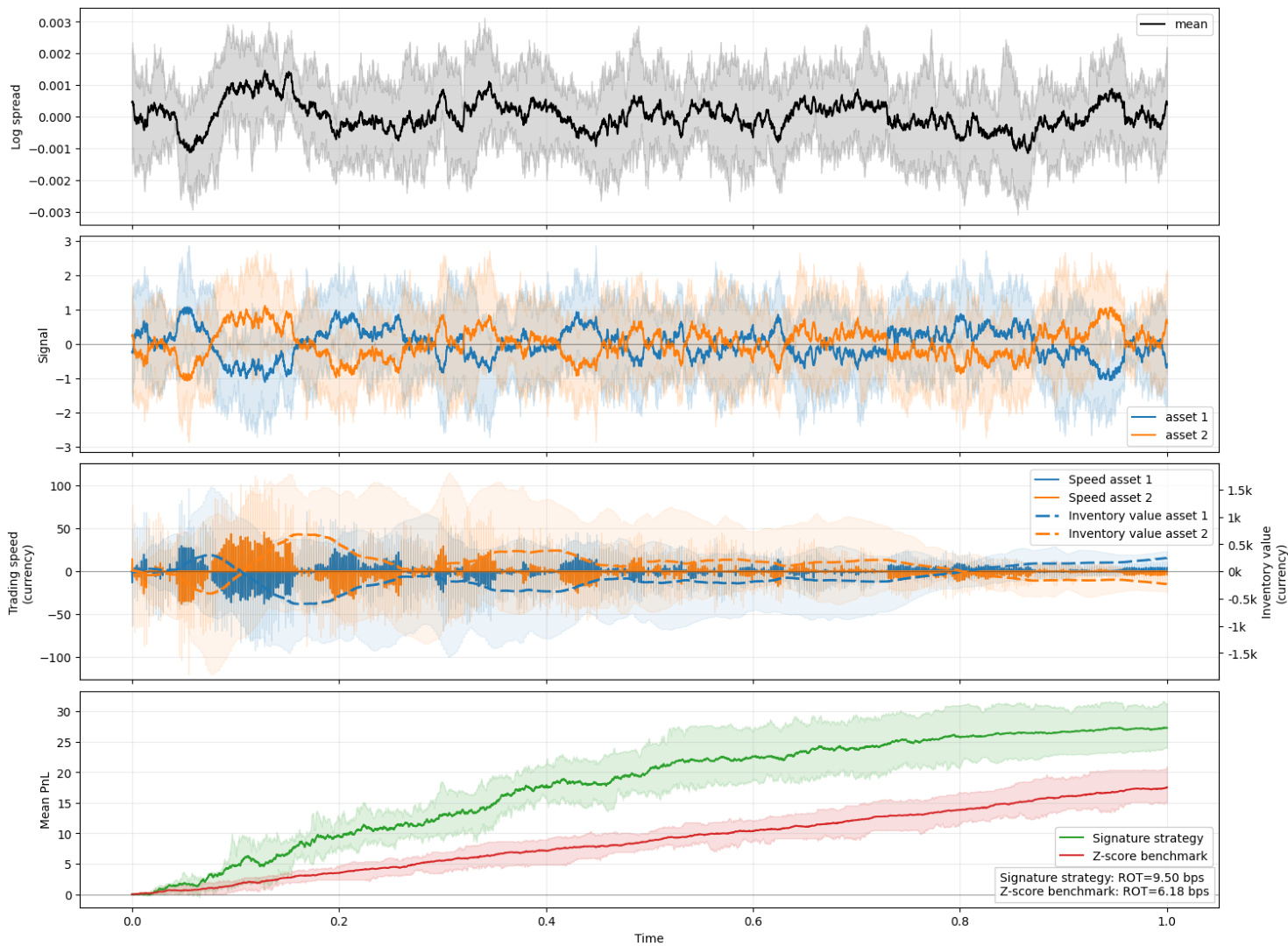
This paper introduces a signature-based framework for optimal execution in statistical arbitrage with path-dependent signals, unifying alpha generation and execution within a single truncated signature state. A central quadratic reduction theorem shows that, when trading speeds are restricted to signature-linear controls, the path-dependent execution problem becomes a finite-dimensional concave quadratic program that can be solved off-line; live execution then reduces to a single matrix-vector multiplication. The approach is demonstrated on synthetic mean-reverting log-spread dynamics and on a historical equity-pairs workflow (Shell–BP), where the learned policy outperforms a standard z-score benchmark on accounting metrics such as return on turnover . The framework also connects with classical Almgren–Chriss/LQ setups and provides a principled route to incorporate temporary impact, inventory risk, and dollar-neutrality within a single optimisation .