Mapping Diplomatic Representation in Europe, 1648–1715
发表于 2026年7月15日上传于 2026年7月16日
This working paper introduces a new quantitative dataset on European diplomatic representation for 1648–1715, drawn from Band I of the Repertorium der diplomatischen Vertreter aller Länder. It documents 13,344 missions across 141 sending and 201 receiving polities, involving 8,852 representatives, with high temporal granularity (dates to the day for the majority of opening acts). The paper describes source and coding procedures, assesses data quality and limitations, and highlights patterns in participation, rank, and mission duration. An illustrative application shows that while ruler successions affected individual appointments, the international network of relationships remained durable, signaling a tension between patrimonial and impersonal structures in the early modern state. The dataset is positioned to inform research on recognition, status hierarchies, and state formation, with Bands II–III to extend the series to 1815.
Governing Artificial Intelligence: Public Preferences and Regulatory Options
发表于 2025年12月1日上传于 2026年7月17日
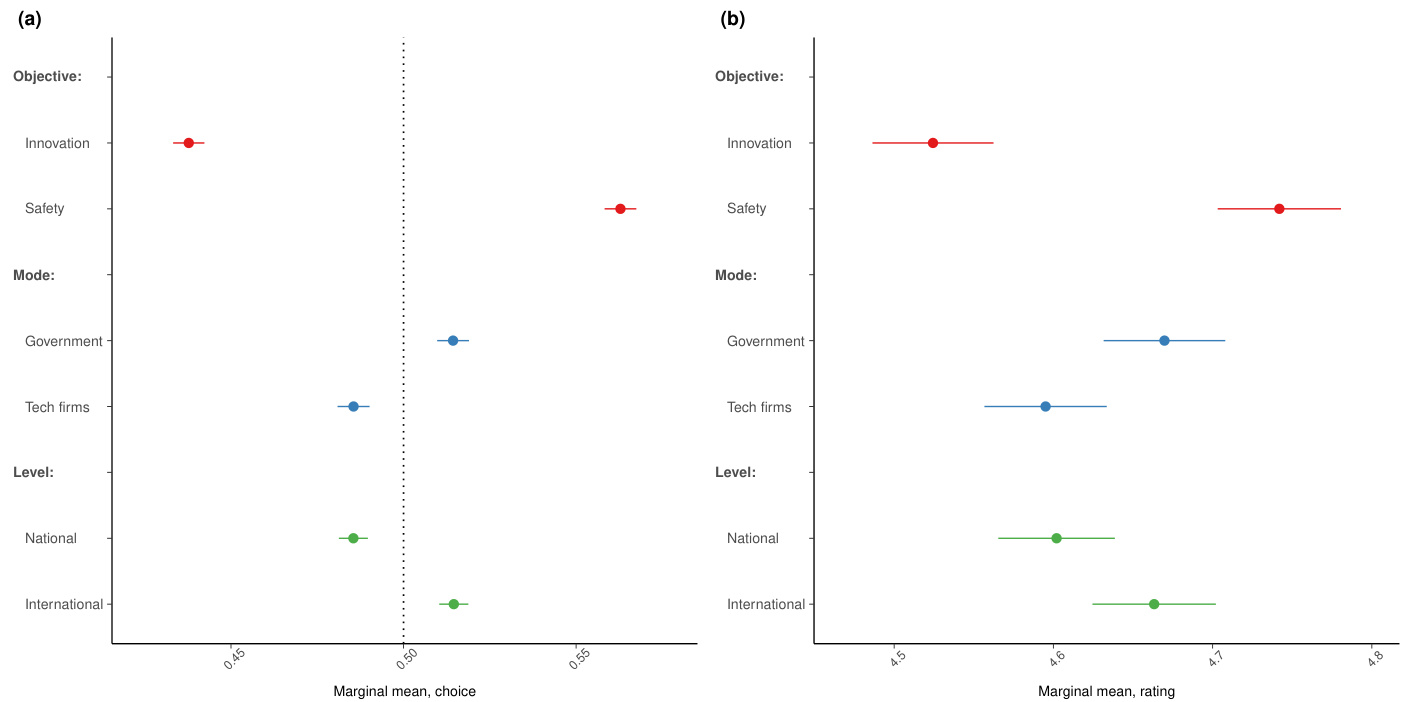
This study investigates how citizens across seven countries evaluate competing AI governance designs using a three-dimensional conjoint experiment (objective: safety vs. innovation; mode: public vs. private; level: national vs. international) across three domains (workplace, policing, warfare). It finds broad support for AI regulation with a robust preference for safety over innovation, public governance over private self-regulation, and international over national regulation. The strength of the safety preference is higher among those who perceive AI as risky, unpredictable, and personally consequential. The findings imply a systematic misalignment between dominant national models (e.g., US, China) and citizen preferences, highlighting the political salience of risk perceptions in AI governance .