This paper develops an early asset-pricing framework for compute, a scarce, non-storable input central to the AI economy. It argues that storage-based no-arbitrage links cannot directly price compute futures, since a GPU-hour cannot be stored for delivery in the future; instead, futures should be priced via the expected future spot rental price at delivery, adjusted for a risk premium arising from hedging pressure. Using term rental data to construct synthetic futures, the authors build the first compute futures return panel sorted by GPU generation and maturity, finding preliminary evidence of a positive compute risk premium consistent with hedging pressure by compute providers. The analysis highlights how synthetic forward pricing, forward-looking spot expectations, and basis risk shape the evolving price discovery process for AI infrastructure.
Yield Curve Dynamics Using Variational Autoencoders Under No-arbitrage
发表于 2026年7月7日上传于 2026年7月7日
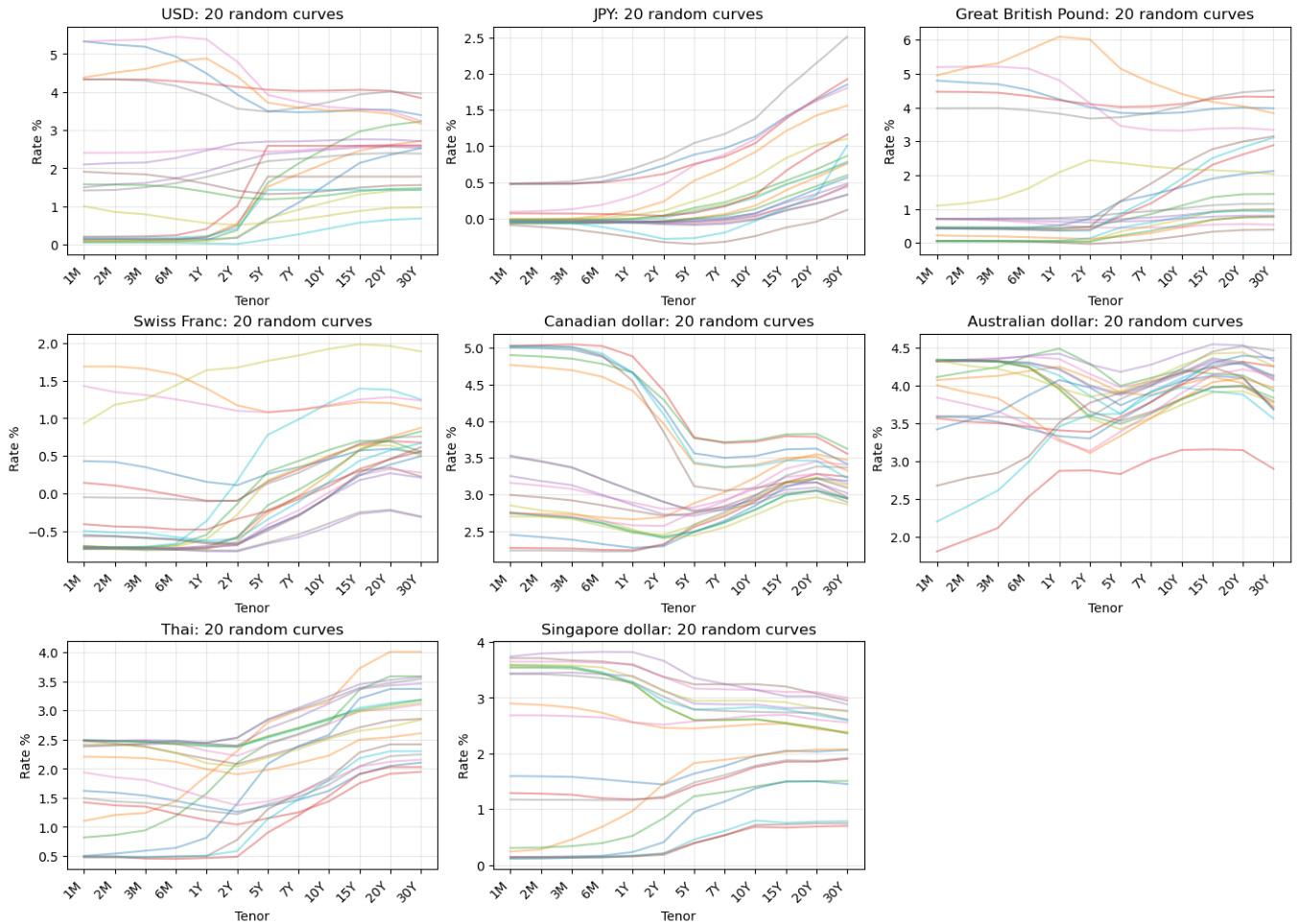
This paper introduces a physics-informed generative framework that resolves the conflict between statistical flexibility and rigorous fixed-income modeling. A two-stage architecture—Stage A CVAEsT + LS (Student-t Conditional VAE with Dynamic Level Injection) and Stage B a continuous-time Neural SDE penalized by a No-Arbitrage PDE—yields an arbitrage-free, heavy-tailed yield-curve manifold. Empirical results across USD, GBP, and JPY show markedly reduced out-of-sample errors (6.58 bps Mean Tenor RMSE), overcoming issues seen in classical HJM and unconstrained baselines, while enabling regime detection and robust scenario generation